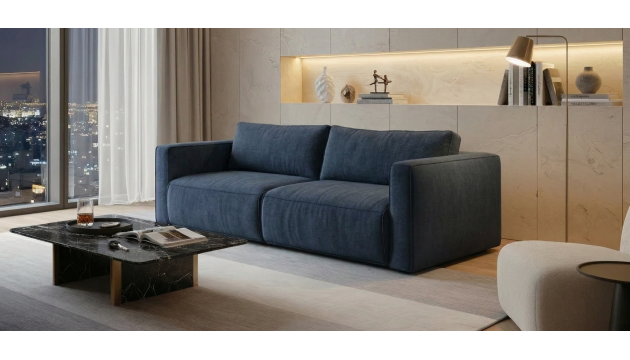
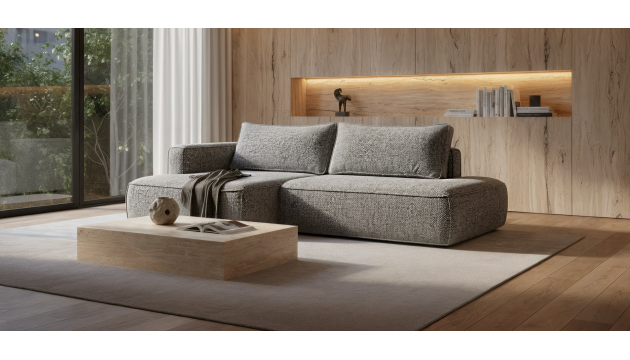
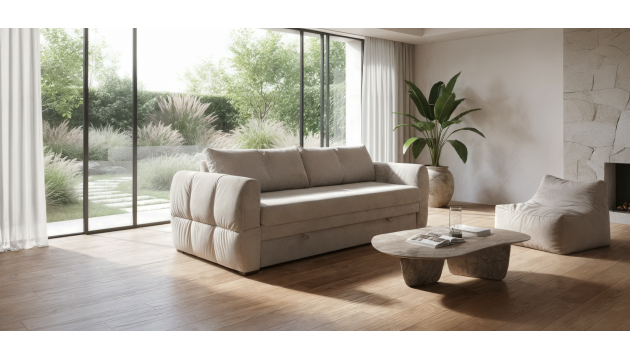
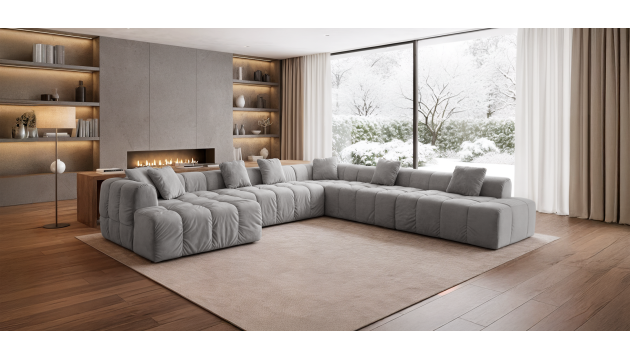
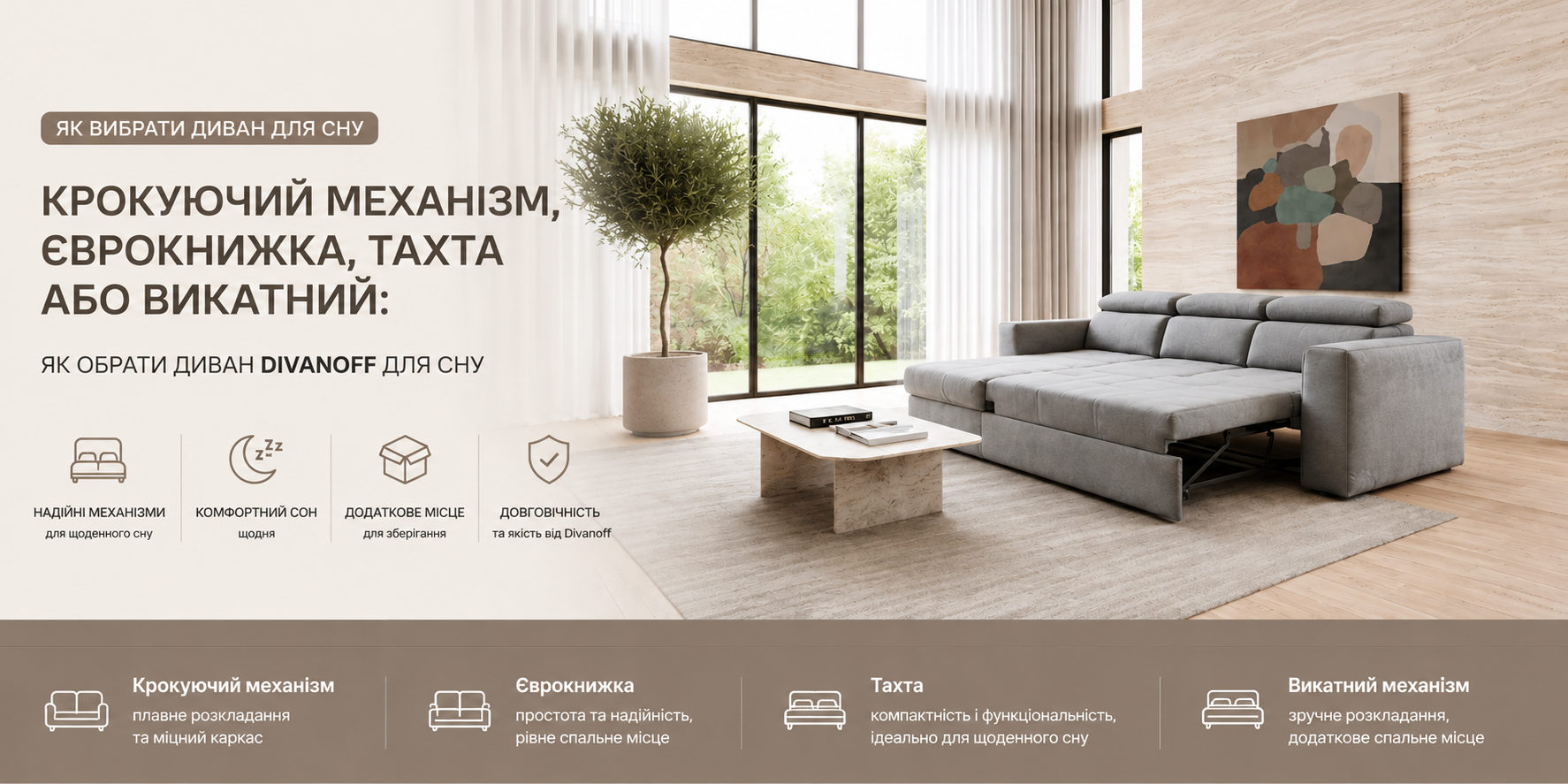
Walking Mechanism, Eurobook, Daybed, or Roll-Out: How to Choose a Divanoff Sofa Bed
Why the Mechanism Matters More Than It Seems
When choosing a sofa, buyers usually look first at fabric, shape, and color — which makes sense, since that's how a sofa is experienced visually every day. But if the sofa also doubles as a bed, it's the transformation mechanism that determines how comfortable it actually is to live with: how quickly it folds out, how flat and even the sleeping surface ends up, whether it can handle daily use, and whether it'll keep working smoothly for years without squeaks or breakdowns.
Before settling on a color or fabric texture — and we covered fabric selection in detail in our article "How to Choose Sofa Fabric: Velour, Cord, or Chenille" — it's worth deciding on the mechanism first, and only then moving on to aesthetics, like the trending greige tone we covered in our 2026 sofa trends article.
Walking Mechanism: Divanoff's Signature Solution
The walking mechanism is an upgraded take on the eurobook, and it's what's installed in the catalog's most popular models: Cliff, Cliff corner, Modo, Modo corner, Modo Mini corner, and Coin Lite. It gets its name from how it works: instead of the seat sliding fully across the floor and scuffing the flooring the way a classic eurobook does, it "walks" forward — alternating its weight across retractable supports until it levels out flush with the backrest into a single sleeping surface.
That motion means the walking mechanism puts less strain on flooring and rails than a classic eurobook, and folding it out takes minimal effort — the whole sofa unfolds in one smooth motion. It's a reliable choice for daily use: the construction is built for regular load and, handled carefully, lasts for years. Another advantage — most models with a walking mechanism include a spacious storage box under the seat, so the sofa doubles as storage as well.
Classic Eurobook: Proven Reliability (Coin Model)
The Coin model uses a classic eurobook mechanism — the same design familiar from countless apartments, just in a modern build. The seat slides forward along rails while the backrest drops into the vacated space, forming a flat, roomy sleeping area. A classic eurobook has very few moving parts, which makes it highly reliable and simple to operate — it's intuitive to fold out without needing instructions. This kind of sofa can sit flush against a wall, and there's storage space under the seat as well.
One thing worth keeping in mind: when unfolded, this mechanism takes up a fair amount of floor depth, so it's worth measuring your room in advance to make sure there's enough clearance once it's open.
Daybed: Simplicity With No Mechanism at All (Modo Tahta, Coin Tahta)
A "tahta" (daybed) isn't really a transformation mechanism so much as an alternative to one: a solid, one-piece construction with no folding parts, designed from the start to be a full sleeping surface with nothing to unfold. The Modo Tahta and Coin Tahta models have no moving mechanical components that could loosen, squeak, or break over time — which by definition gives this kind of construction a longer service life than any folding mechanism.
A daybed is a great choice when the sofa is intended primarily as a bed from the outset — for a kid's room, a home office, or a guest room — rather than as furniture that acts as a sofa by day and converts into a bed at night.
Roll-Out Mechanism: A Simple Solution for Occasional Use (Rif Model)
The Rif model uses a roll-out mechanism — one of the simplest to operate: the seat section rolls forward on casters, revealing an extra sleeping surface. Unfolding takes just seconds and requires no physical effort or special technique. This option works well if the sofa isn't used as a bed every day, but rather now and then — for guests or daytime rest.
Combined Mechanism: A Solution for Corner Sofas (Coin Corner, Coin Mini Corner)
The corner models Coin Corner and Coin Mini Corner use a combined design: the straight section of the sofa unfolds with the familiar walking mechanism, while the corner section lifts and lowers on a gas-lift — smoothly, with no jolts or extra noise. This combination delivers one large, unified sleeping surface even in a corner layout, while keeping the reliability and ease of the walking mechanism for the main section of the sofa.
How to Choose a Mechanism for Your Needs
The main question when choosing is how often the sofa will actually serve as a bed. For daily sleeping, it's worth looking at models with a walking mechanism, a classic eurobook, or a daybed — all three are built for regular load and provide a flat, comfortable sleeping surface. If the sofa only gets unfolded occasionally, for guests, the simpler roll-out mechanism on the Rif model is more than enough.
The second key factor is room size and layout. For a guest room or home office, where the sofa's main job is being a bed, a daybed is a solid choice — there's no mechanism to loosen over time. For a living room, where the sofa needs to work both for sitting and sleeping, a walking mechanism or eurobook model is the better fit. And if you want to combine a corner shape with a full sleeping surface, it's worth considering the Coin Corner or Coin Mini Corner and their combined mechanism.
The filling of the sleeping surface matters too: most Divanoff models use hypoallergenic hollow fiber — a resilient, long-lasting material that keeps its shape over time and works well for allergy-prone households. The Cliff model additionally comes with a spring serpentine combined with quality polyurethane foam, for anyone who prefers a bouncier seating feel.
Making a Mechanism Last
Whatever the mechanism, a few simple habits help it last longer: avoid overloading the sofa while folding or unfolding it, don't sit on the armrests or the very edge of the seat, and avoid sudden, forceful movements when opening or closing it. For models with a walking mechanism or a classic eurobook, a level floor surface matters too — it keeps the rails and supports moving smoothly and evenly. Gas-lift mechanisms (the corner section on the Coin Corner and Coin Mini Corner) generally need minimal upkeep thanks to having fewer moving parts, but it's worth checking once a year that the lift still operates smoothly, without sticking.
Quick FAQ
What's the difference between the walking mechanism and a classic eurobook? Both belong to the eurobook family, but the walking mechanism unfolds through alternating movement on retractable supports rather than the seat sliding across the floor in one motion — that puts less strain on flooring and takes less effort to open.
Which mechanism works best for daily sleeping? The walking mechanism, the classic eurobook, and the daybed are all built specifically for regular, everyday use.
How is a daybed different from the other mechanisms? A daybed isn't a folding mechanism at all — it's a solid construction with no moving parts, ready as a sleeping surface from the start, so it doesn't have the vulnerable joints a folding mechanism does.
Which Divanoff model works best for a guest room where the sofa is unfolded rarely? The Rif model with its roll-out mechanism is a great fit for occasional use — it's simple to operate and needs no getting used to.
The Bottom Line
The transformation mechanism shapes a sofa's everyday comfort far more than its color or fabric texture does. In the Divanoff catalog, the walking mechanism is the most common and versatile choice for daily sleeping, the classic eurobook (Coin) is a time-tested alternative, the daybed (Modo Tahta, Coin Tahta) is a reliable choice with no moving parts, the roll-out mechanism (Rif) is a simple solution for occasional use, and the combined design on the corner models Coin Corner and Coin Mini Corner pairs the spaciousness of a corner shape with the convenience of the walking mechanism. Showroom consultants or the Divanoff website team can help match a model to your specific needs, from nightly sleeping to the occasional guest stay.