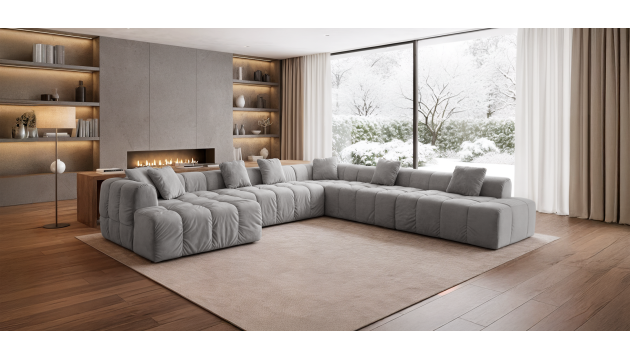
How to Choose a Corner Sofa: Orientation, Size, and the Right Divanoff Model for Your Living Room
Why a Corner Sofa Is More Than a Matter of Taste
Corner sofas are popular for good reason: they seat more people in the same footprint than a straight sofa, put an otherwise often-empty corner of the room to use, and typically offer more storage and a roomier sleeping surface. But that same shape means there are more ways to get a corner sofa wrong — which way the corner faces, its size relative to the room, its position relative to doors and windows. A straight sofa is simpler in this respect: it only really faces one way — toward a wall.
How to Decide Which Side the Corner Should Be On
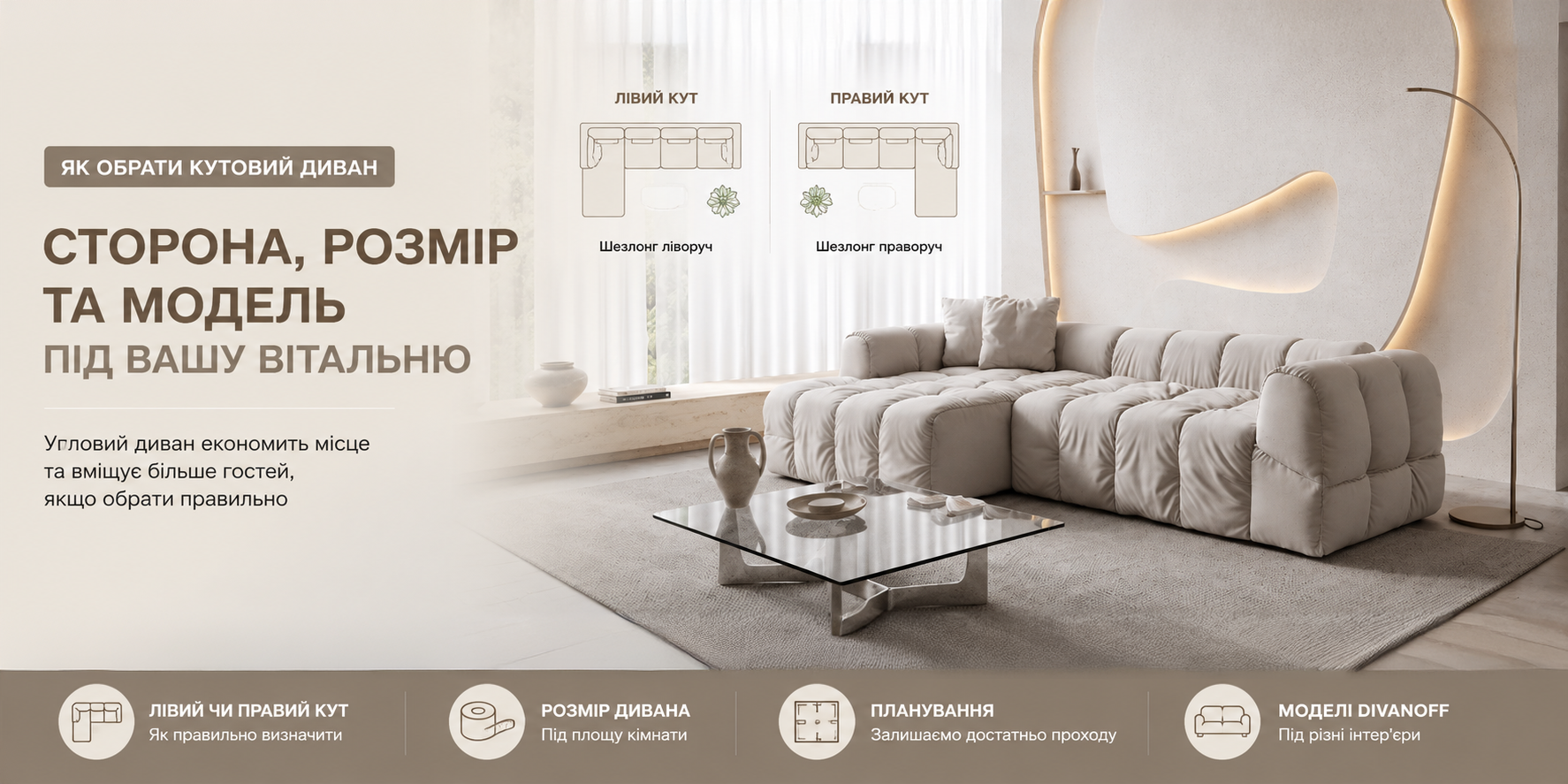
The first and most common question when choosing is whether you need a left or right corner. To figure it out, it helps to mentally map (or sketch on paper) three things in the room: the entry door, the window, and the room's main focal point — usually a TV or a fireplace. The corner should "wrap around" that focal point, not turn away from it: sitting on the long section of the sofa, your line of sight should fall naturally on the screen or window, not get blocked by the armrest on the short side.
The second thing to check is traffic flow through the room. The sofa shouldn't block the main walking path, especially if people frequently pass through to a balcony, kitchen, or another door — in that case, it's worth orienting the short side of the corner so it stays out of the way. And third: if the room has an architectural alcove or recess, a corner sofa often fits most naturally right into it — that's usually the scenario where the shape of the corner suggests itself.
Check with the specific model's page or a showroom consultant on whether the orientation you need is available to order — this varies between manufacturers and models.
How Much Space a Corner Sofa Should Take Up
There's a simple rule of thumb: a sofa shouldn't take up more than roughly a fifth of the room's floor area — beyond that, it starts to visually crowd the space and get in the way of movement. For a 16–18 m² living room, that works out to a sofa with an overall length along its longer side of roughly 2.6–2.9 meters — right in the range of models like the Cliff Corner (260 cm) or the Modo Corner (286 cm). For a more compact room, it's worth looking at the mini versions instead.
The seat's own dimensions matter too: budget at least 60–70 cm of width per person, and a seat depth of 50 cm or more for comfort — enough room to sit without tucking your legs in or sinking too far into the cushions. It's also worth checking the backrest height: the lower the ceilings in the room, the lower the sofa's backrest should be, to keep the space feeling properly proportioned.
Functionality: Storage and the Transformation Mechanism
A corner sofa has a built-in advantage: its shape usually fits more storage under the seat than a straight sofa does. Most Divanoff corner models come with two spacious storage boxes — handy for bedding, pillows, or seasonal items without taking up closet space.
If the sofa will also serve as a bed, it's worth paying attention to the transformation mechanism — we covered this in detail in our article "Divanoff Sofa Mechanisms: Walking, Eurobook, Daybed, Roll-Out." In short: the Coin Corner, Coin Mini Corner, and Coin 2 Corner models use a combined design — the straight section unfolds with a walking mechanism, while the corner section lifts on a gas-lift, giving a single, spacious sleeping surface even in a corner layout. The Modo Corner and Cliff Corner also use a walking mechanism as their main folding system.
Fabric for a Corner Sofa: What to Watch For
A corner sofa usually takes more varied wear than a straight one — people sit on it from different sides, lean on the corner section, use it as a spot to lie down. That makes a durable, protectively treated fabric especially important for corner models — we covered fabric selection in detail in our article "How to Choose Sofa Fabric: Velour, Cord, or Chenille." If the sofa sits in a high-traffic area or near the kitchen, it's worth considering a more practical texture and tone, like the trending greige — it hides everyday marks better, as we discussed in our 2026 sofa trends article.
Which Divanoff Model to Choose
For a spacious living room where the corner sofa will be the main focal point, the Modo Corner is a strong choice — at 286 cm overall with a 223×135 cm sleeping surface, it's one of the roomiest models in the catalog, with two storage boxes and a reliable walking mechanism. If you want a slightly more compact shape with comparable functionality, the Modo Mini Corner is worth a look.
For a mid-sized living room, the Cliff Corner (260×150 cm overall, 200×150 cm sleeping surface) is a solid pick — a spacious sleeping area in a less bulky overall footprint, plus a roomy storage compartment.
If a large, flat sleeping surface is the priority, look at the Coin Corner and Coin 2 Corner: both have a 240×160 cm sleeping surface, two storage boxes each, and the combined transformation mechanism. For a smaller room where you still want a corner shape and a full sleeping surface, the Coin Mini Corner, with its 210×160 cm sleeping surface, is a good fit.
Quick FAQ
How do I know if I need a left or right corner? Mentally place the sofa in the room and check which way the long section faces — it should face the TV, window, or other focal point of the room, and the short side shouldn't block the main walking path.
What size corner sofa should I choose for a small living room? Use the "no more than a fifth of the room" rule of thumb, and look at compact models like the Coin Mini Corner or Modo Mini Corner.
Do Divanoff corner sofas have storage? Yes — most corner models come with two spacious storage boxes under the seat.
Is a corner sofa suitable for daily sleeping? Yes, as long as you pick a model with a reliable transformation mechanism — for example, the Coin Corner or Coin 2 Corner, with their combined walking-mechanism-plus-gas-lift design.
The Bottom Line
Choosing a corner sofa comes down mainly to layout: the right orientation is determined by where the door, window, and focal point of the room sit, and the right size by the room's floor area and the "no more than a fifth of the room" rule. The Divanoff catalog has a model for every scenario — from the compact Coin Mini Corner and Modo Mini Corner for smaller living rooms to the spacious Modo Corner and Coin 2 Corner for larger ones — all with generous storage and reliable transformation mechanisms. Showroom consultants or the Divanoff website team can help you find the right model and confirm which corner orientations are available.



-kopija-630x360.png)